
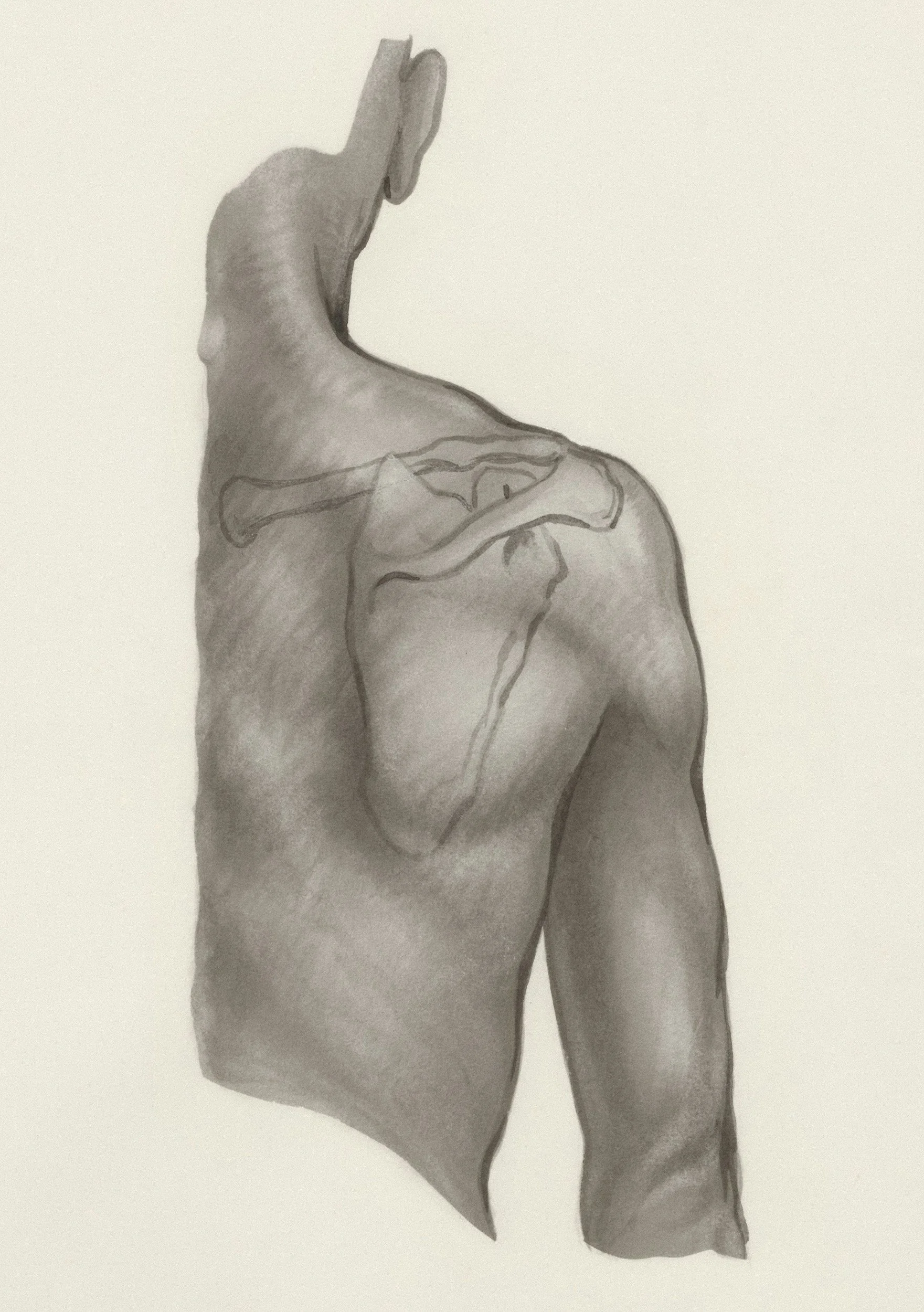
Spinal Accessory
Nerve Pain
That knot in your trap that never goes away? It might not be your trap at all.
You know the spot. The one your partner digs into and you say “right there, that's it!” it feels better for about an hour before it's back.
BOOK AN ASSESSMENT →When “Tight Traps” Keep Coming Back
Most people call it tight traps or rhomboids. Others get told it's general tension from stress and posture.
And they're not entirely wrong, those muscles are involved.
But in a significant number of cases, the reason that tension never fully resolves, regardless of how much massage, stretching or manipulation is applied, is that the problem isn't primarily in the muscle at all.
The Spinal Accessory Nerve
What it is, and why it matters.
The spinal accessory nerve (cranial nerve XI) is one of the twelve cranial nerves that originate from the brain rather than the spinal cord.
It arises from the brainstem, exits the skull, and travels down the back and side of the neck before branching into two main destinations: the sternocleidomastoid muscle at the front of the neck, and the upper trapezius.
It's a motor nerve.
Its job is to control muscle movement, not to carry pain signals.
This is part of why it gets overlooked. Most people think about nerve pain in terms of sensory nerves, the ones associated with tingling, radiating pain or numbness.
Treating the muscle isn't always the same as treating the problem.
The spinal accessory nerve controls the upper trapezius directly. When this nerve is restricted along its path through the neck, the trapezius muscle it supplies can remain chronically tense and sensitive, regardless of how much soft tissue work is applied to the muscle itself.
A Familiar Pattern
The presentation I see consistently in clinic:
Persistent Trap Tension
A persistent ache or tension in the upper traps, between the base of the neck and the top of the shoulder.
Between the Shoulder Blades
Pain or sensitivity that runs between the shoulder blades, sometimes described as rhomboid or intrascapular pain.
That One Spot
A specific tender spot where the neck meets the shoulder, or in the mid-trap region between the spine and shoulder blade.
Temporary Relief
Symptoms ease temporarily with massage or heat, only to return within hours or a day or two.
Treatment Hasn't Shifted It
No lasting change despite repeated adjustments, dry needling or massage sessions targeting the painful area.
The phrase I hear more than almost any other: “my rhomboids are so tight”. In many cases when I assess these patients, the rhomboids and mid-trapezius are not the primary problem. The spinal accessory nerve is what's generating the symptoms. Treating the wrong structure is why the problem doesn't resolve.
DR RUSSELL JENSENDesk Workers Are a Familiar Presentation
In short: almost everyone who spends significant time at a desk.
The spinal accessory nerve travels through the neck in a position that is mechanically loaded by sustained forward head posture, the position many people adopt when looking at a screen, reading, studying or writing.
Over time, chronic irritation and inflammation of the nerve can cause local pain and muscle guarding.
Targeted assessment of the spinal accessory nerve is now a standard part of how I approach almost every neck and upper back presentation.
Why Standard Treatment Doesn't Always Fix It
Massage, stretching and adjustments can all be useful. But they don't necessarily treat the same structure.
It can feel great.
Massage applied to the upper trapezius can temporarily reduce muscle tension and improve how the area feels.
But if the nerve supplying that muscle is the true cause of the symptoms, the muscle can return to its guarded state relatively quickly.
It can improve movement.
Stretching the upper trapezius may provide a brief improvement in range and comfort.
But stretching the muscle doesn't necessarily address a restriction involving the nerve itself.
They treat something different.
Cervical and thoracic adjustments can improve joint mobility and reduce pain.
An adjustment, however, doesn't specifically address the spinal accessory nerve.
None of this means massage, stretching or adjustments are wrong or unhelpful. They can all be part of the picture. But when they're the only tools being used and the nerve is the primary driver, the relief may be partial and temporary.
Find the restriction.
Treat it directly.
Retest the movement.
Because the underlying issue is a nerve, treatment needs to be directed specifically at the nerve.
We use targeted soft tissue therapy applied to the spinal accessory nerve, most commonly at the upper trapezius.
The technique involves specific contact on the nerve combined with controlled movement that creates a mobilising force along the nerve, aiming to break adhesions that may be binding it to the trapezius muscle.
The goal is to restore normal nerve mobility and reduce irritation at adhesion sites that may be contributing to the muscle's chronic guarded state.
How We Approach the Nerve
The principle is straightforward: identify the nerve, find where its movement appears restricted, treat that restriction and assess what changes.
Identify the Structure
We examine the neck, shoulder and upper back and identify the areas that reproduce your familiar symptoms.
Target the Restriction
Specific pressure and controlled movement are used to treat the nerve and surrounding tissue rather than simply massaging the painful muscle.
Measure the Change
We reassess the movement, tenderness and symptoms that were present before treatment to determine how you've responded.
Of all the treatments I apply for neck and upper back pain, spinal accessory nerve work is among the most consistently effective and the most straightforward to apply.
If I had to choose just two treatments for a neck presentation without knowing anything else about the patient, this would be one of them alongside the suboccipital muscles.
Does This Sound Familiar?
A clinical assessment may be worthwhile if you've been dealing with any of the following:
Persistent upper trap tension or aching that returns within a day or two of massage or treatment.
Pain or sensitivity between the shoulder blades that doesn't respond to stretching or adjustment.
A specific tender spot at the corner of the neck or in the mid-trap region that you've been managing for months or years.
Neck stiffness or restricted rotation alongside upper back tightness.
You've been told it's your rhomboids or mid-traps and treatment targeting those areas isn't producing lasting change.
The following symptoms alongside neck and upper back pain warrant prompt medical assessment rather than chiropractic care as a first step:
- Significant arm weakness or hand clumsiness that has developed recently
- Unexplained weight loss alongside neck or upper back pain
- Symptoms that are rapidly and progressively worsening
Frequently Asked Questions
What is the spinal accessory nerve? +
The spinal accessory nerve (cranial nerve XI) originates from the brainstem and travels down the back of the neck, supplying the upper trapezius and sternocleidomastoid muscles.
It is a purely motor nerve, which means it controls muscle movement. It is frequently overlooked as a contributor to persistent upper back, neck and intrascapular pain.
Can the spinal accessory nerve cause upper back and trap pain? +
Yes. When the spinal accessory nerve is irritated, the trapezius muscle it supplies can remain chronically tense and painful regardless of how much soft tissue work is applied to the muscle itself.
Addressing the nerve directly is often what produces lasting change when other treatments have provided only temporary relief.
Why do my traps feel permanently tight no matter what I do? +
Persistent trap tightness that doesn't respond to massage, stretching or spinal adjustment is often being driven by something other than the muscle.
The spinal accessory nerve is a frequently missed contributor. When this nerve is irritated or trapped, the muscle it supplies can remain in a chronically guarded state regardless of how much treatment is directed at the muscle.
What is intrascapular pain? +
Intrascapular pain is pain felt between the shoulder blades.
It is commonly attributed to tight rhomboids or mid-trapezius muscles. While these can be involved, persistent intrascapular pain that doesn't respond to treatment of those muscles may involve the spinal accessory nerve or other cervical nerve structures.
How is spinal accessory nerve dysfunction treated? +
We use targeted soft tissue therapy directed at the spinal accessory nerve, usually at the upper trapezius, aiming to restore normal nerve mobility and reduce irritation at sites where the nerve may be adhered or trapped.
This is distinct from general trap massage and targets the nerve rather than the muscle. Results are assessed at each visit and treatment is adjusted accordingly.
Persistent upper trap tension or mid-back pain that treatment hasn't been able to shift?
A clinical assessment can help identify whether the spinal accessory nerve is contributing and give you a clearer path forward.