
Shockwave Therapy Perth:
Focused and Radial ESWT in Bicton
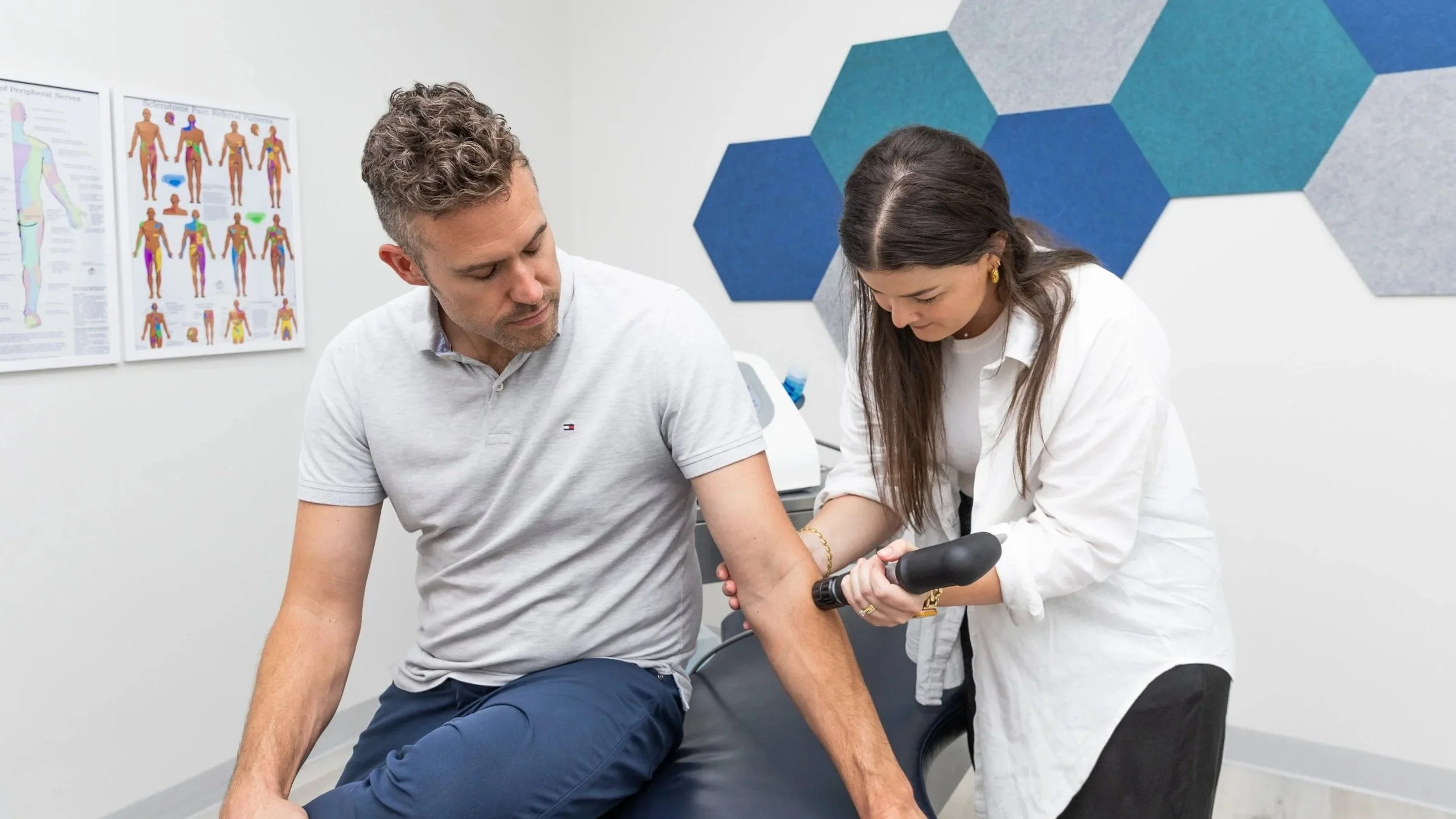
I provide shockwave therapy from Southside Spine & Sport in Bicton, Perth, using both focused shockwave and radial pressure wave therapy.
My focused system is a PiezoWave2, which can treat deeper structures. My radial system is a Chattanooga RPW2, which is best suited to shallow structures.
Which one is used depends on what is found during your assessment.
BOOK ASSESSMENT →The key things to know
What Conditions Can Shockwave Therapy Help?
Shockwave has been studied across a wide range of musculoskeletal conditions, but the evidence varies across the spectrum of treatable conditions.
For some problems, there is a reasonably established body of research. For others, the evidence is promising but developing.
These are some of the conditions we use Shockwave Therapy for.
Calcific Rotator Cuff Tendinopathy
Calcific rotator cuff tendinopathy is one of the clearest applications for shockwave therapy.
In this condition, calcium deposits develop within one or more of the rotator cuff tendons. Shockwave has been studied for its effects on pain, shoulder function and the calcific deposit itself.
Plantar Fasciitis / Fasciopathy
Persistent plantar heel pain is one of the most extensively researched applications for shockwave.
Recent systematic reviews support ESWT as a useful conservative treatment for plantar fasciopathy, with improvements in pain reported across both focused and radial protocols.
But shockwave doesn't remove the need to understand why the plantar fascia became a problem. Foot and ankle capacity, calf strength, activity, footwear and loading can all matter, and those things may still need to be addressed.
Read more about plantar fascia and foot pain →Achilles Tendinopathy
Shockwave is also used for persistent Achilles tendinopathy, although the research is less straightforward than it is for plantar fasciopathy.
Some studies report useful improvements, particularly when shockwave sits alongside an appropriate tendon-loading programme. Other reviews have found the evidence too inconsistent or low in quality to conclude that shockwave is clearly superior to other conservative approaches.
That is why I generally think of shockwave as just a part of comprehensive Achilles rehabilitation management plan.
Read more about Achilles tendinopathy →Tennis Elbow
Lateral elbow tendinopathy, usually called tennis elbow, is another common reason people look for shockwave therapy.
Research here is mixed, but some of the more recent evidence is encouraging.
A 2024 systematic review and meta-analysis of six randomised trials compared shockwave directly with corticosteroid injection for chronic tennis elbow. Corticosteroid injection produced better results in the short term, at around one month. However, by three and six months, shockwave produced better outcomes for pain, grip strength and patient-rated function.
That makes shockwave particularly interesting for persistent tennis elbow.
It still isn't a guaranteed fix, and rehabilitation and appropriate tendon loading remain important. But for someone considering an injection, shockwave may be a reasonable non-invasive option to discuss before moving to corticosteroid treatment.
Read the complete Shockwave Therapy for Tennis Elbow guide →Gluteal Tendinopathy & Greater Trochanteric Pain Syndrome
Shockwave is increasingly used for persistent pain around the outside of the hip associated with gluteal tendinopathy and greater trochanteric pain syndrome, or GTPS.
The evidence here is encouraging.
Recent reviews have found short-term improvements that favour shockwave in some comparisons, while also identifying important limitations in the quality of the available trials.
For most of patients it is a helpful option, usually alongside appropriate hip loading and management.
Patellar Tendinopathy
Shockwave has also been studied for persistent patellar tendinopathy, although the evidence here is mixed.
Some studies have reported meaningful improvements following shockwave treatment, and a recent systematic review found favourable short-term pain outcomes when shockwave was compared with other conservative treatments. However, when shockwave has been added to an eccentric loading programme, it has not consistently produced better results than the same exercise programme with sham shockwave.
For that reason, progressive tendon loading remains the foundation of treatment for patellar tendinopathy.
I still encourange patients to consider shockwave in selected cases, particularly when a tendon has not responded as expected to an appropriate rehabilitation programme, but I would use it as part of a comprehensive management plan.
Carpal Tunnel Syndrome
Shockwave has also been studied as a non-invasive treatment for mild-to-moderate carpal tunnel syndrome.
A 2023 systematic review and meta-analysis included 19 randomised controlled trials and found that shockwave produced improvements in symptoms and hand function, as well as measurable changes in nerve-conduction testing and the cross-sectional area of the median nerve.
There are also some interesting comparisons with corticosteroid injection. Short-term outcomes were similar, but at medium- and longer-term follow-up, shockwave produced better improvements in pain and function.
Both focused and radial shockwave have been studied for carpal tunnel syndrome.
The evidence is encouraging, but it isn't definitive.
For someone with mild-to-moderate carpal tunnel syndrome looking at conservative treatment options, I think the current evidence makes shockwave a reasonable non-invasive option to consider.
Proximal Hamstring Tendinopathy
Shockwave has been studied specifically for proximal hamstring tendinopathy, rather than simply being extrapolated from other tendon conditions.
One randomised trial in athletes with chronic proximal hamstring tendinopathy found that shockwave produced greater improvements in pain and function than a multimodal treatment programme. At follow-up, 80% of the athletes treated with shockwave had returned to their pre-injury level of sport, compared with none in the comparison group.
More recent research has been less dramatic. A 2025 randomised trial comparing shockwave with individualized physiotherapy found no significant difference between the two approaches for overall improvement or function, although satisfaction was higher in the shockwave group at several time points.
Taken together, I think the evidence supports shockwave as a reasonable non-invasive option for persistent proximal hamstring tendinopathy, particularly when symptoms have not responded as expected to rehabilitation alone.
As with other tendinopathies, I would generally use it alongside an appropriate progressive loading program.
The evidence isn't equal for every condition.
Shockwave has a stronger evidence base for problems such as plantar fasciopathy and calcific rotator cuff tendinopathy than it does for some other tendon and nerve conditions.
Focused vs Radial Shockwave Therapy:
What's the Difference?
People often ask which one is better.
Focused shockwave and radial pressure wave therapy are physically different technologies.
Radial Pressure Wave Therapy
Radial treatment produces mechanical pressure waves at the applicator that spread through the tissues underneath it.
The energy is greatest closer to the surface and disperses as it travels deeper.
- The target is relatively superficial
- A broader treatment area makes sense
- The highest energy doesn't need to be concentrated at one specific depth
Focused Shockwave Therapy
Focused shockwave works differently.
Instead of producing its greatest effect at the surface and allowing that energy to disperse, focused shockwave allows acoustic energy to be concentrated within a focal zone at a selected depth.
- Deeper beneath the skin
- Relatively small
- Anatomically specific
- Easier to identify at a known depth
- Better suited to a more concentrated treatment field
Focused isn't automatically better. Radial isn't automatically worse.
A 2026 systematic review and meta-analysis directly comparing focused and radial shockwave across upper and lower limb tendinopathies found no clear overall superiority of either treatment for pain or function. The certainty of most of that comparative evidence was low or very low.
They are different tools. Having access to both means I can choose according to the anatomy and treatment goal.
How Does Shockwave Therapy Work?
Despite the name, shockwave therapy does not involve passing an electrical shock through your body.
Experimental research suggests shockwave can influence cellular signalling, local circulation, tendon-cell activity, pain processing and tissue remodelling. In calcific tendinopathy, certain shockwave protocols may also contribute to fragmentation or resorption of calcium deposits.
What Does Shockwave Treatment Feel Like?
During Treatment
Most people describe radial treatment as repeated firm tapping or pressure. Focused shockwave can feel similar but deeper and harder to localise based on feeling alone.
Sensitive areas can certainly be uncomfortable, but treatment intensity can be adjusted to tolerance.
The shockwave component of the consultation usually takes only several minutes.
How Many Sessions?
It depends on the condition.
For many musculoskeletal problems, around 3 to 6 treatments spaced roughly a week apart is a common starting range.
After Treatment
Some soreness, redness or occasional bruising can occur after treatment.
For most people this settles relatively quickly.
What you should do afterwards depends on what we've treated.
For tendon problems, for example, I may temporarily modify heavier loading before building it back up. In other situations there may be very little restriction at all.
We give advice based on your particular problem.
How I Use Shockwave at Southside
Before deciding to use shockwave we need to know things like:
Shockwave is part of the plan — not the whole plan.
For a tendon problem, shockwave may sit alongside progressive loading and activity modification.
For a peripheral nerve problem, treatment may also involve targeted work to the tissues around the nerve.
Other presentations may need joint treatment, rehabilitation, imaging, another practitioner involved, or no shockwave at all.
You don't need to know which type of shockwave you need before you book.
We assess the problem first, decide whether shockwave makes sense, and then choose the treatment approach around what we find.
No additional shockwave fee.
At Southside Spine & Sport, I don't charge an additional fee.
If focused or radial shockwave is appropriate during your consultation, it can be included as part of that treatment without a separate shockwave surcharge.
That applies to both the PiezoWave2 focused system and the Chattanooga RPW2 radial system.
I prefer it that way so that we have the freedom to choose what is best for your problem, not what is going to cost less.
Is Shockwave Therapy Covered by Private Health Insurance?
There isn't a special private health insurance rebate simply for shockwave.
At Southside, shockwave is delivered as part of a chiropractic consultation when clinically appropriate.
Whether you receive a rebate therefore depends on your individual extras cover, your remaining chiropractic benefits and the rules of your health fund.
Read our write up on shockwave therapy and private health insurance in Australia →Who Isn't Shockwave Therapy Suitable For?
Shockwave is generally well tolerated when it is used appropriately, but that doesn't mean it is suitable for everyone or every part of the body.
There are situations where treatment may need to be avoided, modified or discussed with another healthcare provider first.
These can include things such as:
There are also anatomical areas that require particular care, particularly when using focused shockwave because treatment can be directed deeper into the body.
If there is anything in your medical history that changes whether shockwave is appropriate, we'll discuss it before treatment.
Shockwave Therapy Perth: Frequently Asked Questions
How Much Does Shockwave Therapy Cost in Perth?
At Southside Spine & Sport, there is no separate shockwave treatment fee. If focused or radial shockwave is appropriate, it can be included within your normal consultation.
Is Shockwave Therapy Covered by Private Health Insurance?
There isn't a separate private health rebate specifically for the shockwave machine. Because shockwave is used here as part of a chiropractic consultation, your rebate depends on your chiropractic extras cover, remaining limits and individual policy.
Read the full private health insurance article.
Is Shockwave Therapy Covered by Medicare?
There is no standard Medicare item specifically for shockwave therapy delivered during a chiropractic consultation. Some people may qualify for Medicare-supported allied health care through a GP-managed chronic condition arrangement, but that relates to eligibility for the consultation rather than a separate shockwave rebate.
How Many Shockwave Sessions Will I Need?
It depends on the condition. A short course of approximately 3 to 6 treatments, usually spaced around a week apart, is common for many musculoskeletal applications.
Does Shockwave Therapy Hurt?
It can be uncomfortable over a sensitive structure, particularly at higher treatment intensities. Most people tolerate it well, and the intensity can be adjusted during treatment. Some temporary soreness, redness or bruising can occur afterwards.
What Is the Difference Between Focused and Radial Shockwave?
Radial pressure wave therapy delivers energy most strongly near the applicator and treats a relatively broad area from the surface. Focused shockwave allows acoustic energy to be concentrated at a selected depth. I use both and choose according to the anatomy, diagnosis and treatment goal.
Is Focused Shockwave Better Than Radial Shockwave?
Not as a blanket rule. A 2026 systematic review directly comparing focused and radial shockwave across tendinopathies found no clear overall superiority of either for pain or function. The advantage of having both is choice.
What Conditions Have the Best Evidence for Shockwave Therapy?
Shockwave has a particularly established research base for problems including plantar fasciopathy and calcific rotator cuff tendinopathy. Achilles tendinopathy, gluteal tendinopathy, lateral elbow tendinopathy and other tendon conditions have also been studied, but the strength and consistency of the evidence varies.
Can Shockwave Help Shoulder Bursitis?
Sometimes, but the important question is what is actually producing the shoulder pain. Shockwave has a stronger evidence base for rotator cuff tendinopathy, particularly calcific rotator cuff tendinopathy, than it does for directly treating an inflammed bursa. If you've been told you have shoulder bursitis, I still assess the shoulder to determine which structures appear to be involved before deciding whether shockwave makes sense. Read more about shoulder bursitis and impingement.
Can Shockwave Help Nerve Pain?
Possibly, for selected peripheral nerve entrapment problems. Carpal tunnel syndrome currently has the strongest research base, although the certainty of that evidence remains low. Evidence for less common nerve entrapments is much thinner, so I don't assume that research involving the median nerve at the wrist automatically applies to every nerve in the body.
Read about cluneal nerve entrapment and lower back pain.
Do I Need a Referral for Shockwave Therapy?
No. You can book directly with Southside Spine & Sport for an assessment.
Shockwave Therapy in Bicton, Perth
Southside Spine & Sport is located at Unit 2, 6 Fifth Street, Bicton WA 6157, behind Melville Plaza.
I see patients from Bicton and surrounding areas including Melville, Palmyra, Attadale, Applecross, East Fremantle and Fremantle.
Not sure if shockwave is right for you?
You don't need to decide that before you book. I'll assess what's going on first, explain what I think is causing the problem, and let you know whether focused shockwave, radial shockwave, another treatment or no shockwave at all makes the most sense.
Evidence & References
- Brindisino F, Marruganti S, Lorusso D, Cavaggion C, Ristori D. The effectiveness of extracorporeal shock wave therapy for rotator cuff calcific tendinopathy: a systematic review with meta-analysis. Physiotherapy Research International. 2024;29(3):e2106.
- Lippi L, Folli A, Moalli S, et al. Efficacy and tolerability of extracorporeal shock wave therapy in patients with plantar fasciopathy: a systematic review with meta-analysis and meta-regression. European Journal of Physical and Rehabilitation Medicine. 2024;60(5):832–846.
- Charles R, Fang L, Zhu R, Wang J. The effectiveness of shockwave therapy on patellar tendinopathy, Achilles tendinopathy, and plantar fasciitis: a systematic review and meta-analysis. Frontiers in Immunology. 2023;14:1193835.
- Stania M, Malá J, Chmielewska D. The efficacy of extracorporeal shock wave therapy as a monotherapy for Achilles tendinopathy: a systematic review and meta-analysis. Journal of Chiropractic Medicine. 2023;22(4):294–301.
- Karanasios S, Tsamasiotis GK, Michopoulos K, Sakellari V, Gioftsos G. Clinical effectiveness of shockwave therapy in lateral elbow tendinopathy: systematic review and meta-analysis. Clinical Rehabilitation. 2021;35(10):1383–1398.
- Harding D, Cameron L, Monga A, Winter S. Is shockwave therapy effective in the management of greater trochanteric pain syndrome? A systematic review and meta-analysis. Musculoskeletal Care. 2024;22(2):e1892.
- Rhim HC, Shin J, Beling A, et al. Extracorporeal Shockwave Therapy for Greater Trochanteric Pain Syndrome: A Systematic Review with Meta-Analysis of Randomized Clinical Trials. JBJS Reviews. 2024;12(8).
- Stania M, Pawłowski M, Benduch M, et al. Efficacy of radial and focused shockwave therapy for tendinopathy: a systematic review and meta-analysis. Scientific Reports. 2026;16:7632.
- Zhang L, Yang T, Pang L, et al. Effects of Extracorporeal Shock Wave Therapy in Patients with Mild-to-Moderate Carpal Tunnel Syndrome: An Updated Systematic Review with Meta-Analysis. Journal of Clinical Medicine. 2023;12(23):7363.