
Chiropractic Adjustments in Perth - Manual and Low-Force Care in Bicton
If you're dealing with back pain, neck pain, headaches, or a nagging injury that won't settle, a chiropractic adjustment could be exactly what your body needs to start moving properly again. At Southside Spine & Sport in Bicton, Dr Russell Jensen provides evidence-based chiropractic adjustments tailored to each patient - whether that's manual techniques, low-force methods, or a combination of both.
We don't take a one-size-fits-all approach. Every patient gets a proper assessment first, a clear explanation of what's going on, and a treatment plan built around their specific situation and goals.
What Is a Chiropractic Adjustment?
A chiropractic adjustment is the application of a specific, controlled force applied to a spinal joint or other joint that has become restricted - not moving as it should. That restriction creates a chain reaction: surrounding muscles tighten to compensate, nerve function can be affected, and pain or stiffness develops in areas that may seem unrelated to the original problem.
The adjustment restores proper movement to that joint. When movement is restored, the compensation patterns downstream start to unwind, nerve irritation settles, and the body can get back to functioning the way it's supposed to.
Adjustments can be applied to the spine - upper, mid, and lower back - as well as to peripheral joints like the hips, shoulders, knees, ankles, and ribs. The technique used depends on the joint being treated, the patient's condition, and their preference.
What is the popping sound?
The sound you sometimes hear during an adjustment is called a cavitation. Spinal joints are synovial joints - sealed spaces filled with fluid and enclosed by a ligamentous capsule. When the joint is moved quickly through its range, the capsule volume increases momentarily, and gases dissolved in the fluid coalesce into a small bubble. That bubble forms rapidly and that's the sound you hear.
It's not bones cracking. It's not anything breaking or being forced. The bubble dissolves back into the fluid over the next 20 minutes or so. Not every adjustment produces this sound, and the absence of it doesn't mean the adjustment hasn't worked.
Manual and Low-Force Adjustments - What's the Difference?
Not everyone wants or needs the same type of adjustment. At Southside Spine & Sport, Dr Jensen is trained in both manual and low-force techniques, and chooses the approach based on what's appropriate for each patient.
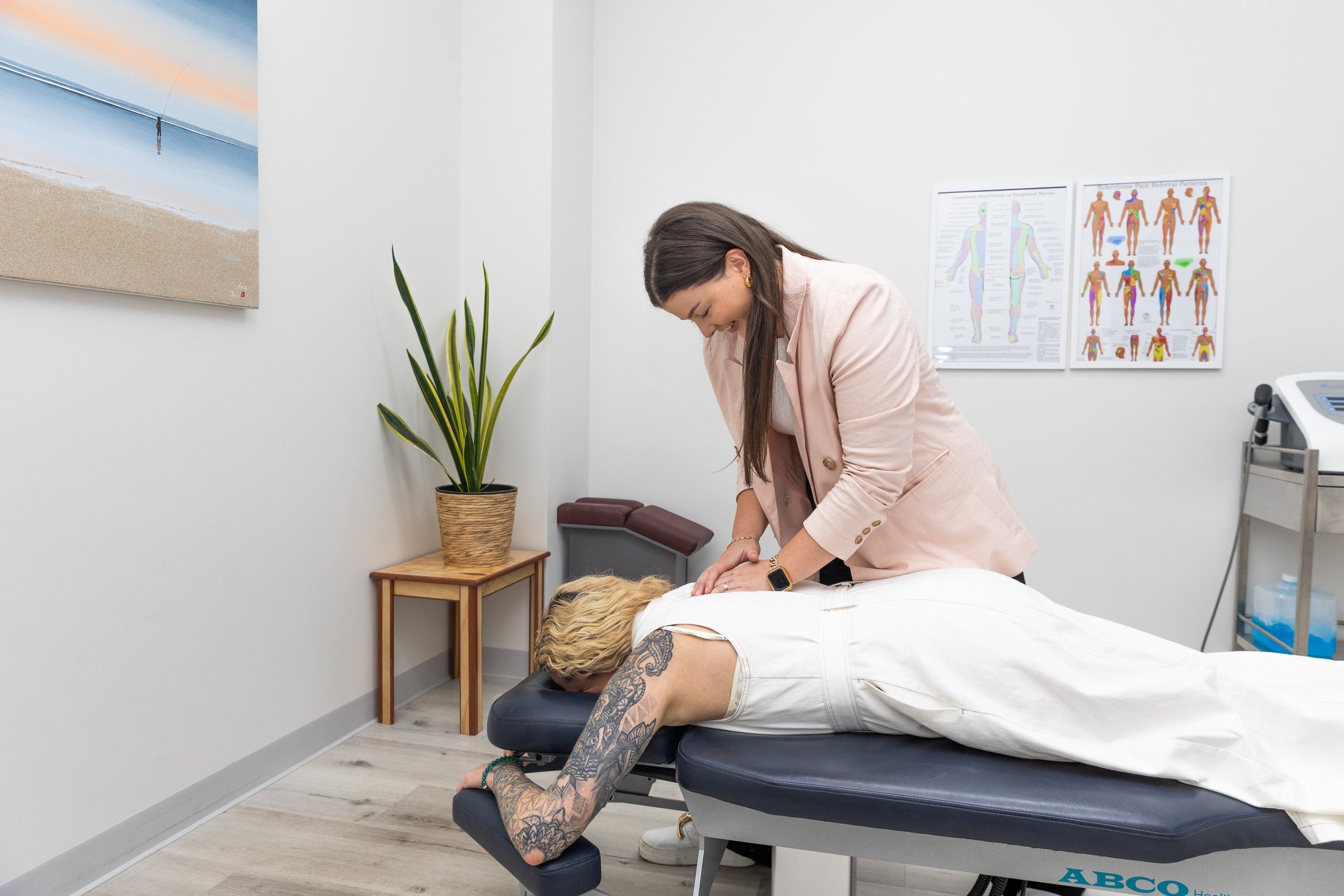
Manual adjustments involve a precise, short thrust applied by hand to the target joint. This is the traditional chiropractic technique - fast, specific, and effective. It's well-suited to most adults with musculoskeletal pain and restricted joint movement.
Low-force adjustments achieve the same clinical goal - restoring joint movement and reducing pain - without the high-velocity thrust. These techniques use sustained pressure, gentle mobilisation, or instrument-assisted methods to work through joint restrictions more gradually. They're particularly appropriate for patients who are nervous about manual techniques, those with acute pain or inflammation, older patients with more fragile joints, or anyone who simply prefers a gentler approach.
The choice isn't about which is better - both achieve good outcomes. It's about matching the technique to the patient. Dr Jensen will discuss the options with you before any treatment begins, and your comfort and preference always inform the approach taken.
Conditions We Treat
Chiropractic adjustments at our Bicton clinic are used to treat a wide range of musculoskeletal conditions. The patients we see most often come from Bicton, Attadale, Melville, East Fremantle, Palmyra, and the surrounding suburbs - though we see patients from across the Perth metro area regularly.
Back Pain
Lower back pain is the most common reason people seek chiropractic care, and for good reason - the lumbar spine takes a significant load through daily life and is vulnerable to both acute injury and chronic dysfunction. Chiropractic adjustments restore movement to restricted lumbar and sacroiliac joints, reduce the muscle guarding and compensation that builds up around the site of pain.
Mid back pain, often driven by thoracic stiffness and postural load, responds well to adjustment combined with soft tissue work. Upper back and rib pain - common in people who sit for long periods - is also regularly treated at our clinic.
Neck Pain and Headaches
Restricted movement in the cervical spine is one of the most common findings in patients with persistent neck pain, tension headaches, and even some migraines. The joints of the upper cervical spine are usually involved with headache patterns. Which is why many patients who come in for neck pain find their headaches improve significantly as well.
Chiropractic adjustments to the cervical and thoracic spine, combined with soft tissue treatment to the surrounding musculature, consistently produce good outcomes for neck pain and headache patients.
Sciatica and Nerve Pain
Sciatica - pain that runs from the lower back through the buttock and down the leg - is most commonly caused by disc or joint problems in the lumbo-sacral spine. Chiropractic adjustments reduce pain by restoring joint movement.
At Southside Spine & Sport, we also treat cluneal nerve pain - a frequently missed cause of lower back and buttock pain that is often misdiagnosed as disc or joint problems. Getting the right diagnosis matters enormously here, because treating the wrong structure produces little to no improvement.
Sports Injuries
Sports injuries often involve a combination of joint restriction, soft tissue damage, and altered movement patterns - all of which benefit from the multi-modal approach at Southside Spine & Sport. Chiropractic adjustments improve the movement restrictions that alter how an athlete moves and loads their body. Combined with soft tissue therapy to address adhesions and rehabilitative exercise to rebuild strength and stability, this integrated approach gets athletes back to training faster.
We treat everything from acute ankle sprains and shoulder injuries to chronic overuse problems in runners, volleyball players, and gym-goers across the Perth.
Postural and Movement Problems
Desk workers, tradies, and anyone who spends significant time in repetitive postures tend to develop predictable patterns of joint restriction and muscular imbalance over time. These patterns don't always cause pain immediately - but they create the conditions for pain to develop, and they reduce performance and movement quality well before that happens.
The Southside Approach - More Than Just an Adjustment
Most chiropractic clinics deliver adjustments as the primary - and often only - treatment. At Southside Spine & Sport, the adjustment is one component of a broader clinical approach.
Dr Russell Jensen trained in Integrative Diagnosis (ID) in the United States - a systematic framework for identifying the specific tissue causing a patient's pain and applying very specific treatments to it. This approach shapes how every patient at Southside is assessed. The aim is to identify exactly what structure is involved and why - which leads to more targeted treatment and better outcomes.
In practice, this means most patients receive a combination of chiropractic adjustment, hands-on soft tissue therapy to release adhesions and restore muscle function, and where appropriate, shockwave therapy for chronic tendon and soft tissue conditions. Rehabilitative exercises are integrated into the plan to build the strength and movement capacity needed to prevent the problem from recurring.
Appointments at Southside Spine & Sport are 15 minutes standard - long enough for proper assessment, treatment, and a conversation about how things are progressing.
What to Expect at Our Bicton Clinic
Your first visit: Dr Jensen will take a thorough history - not just about your current pain, but about its history, what makes it better or worse, and what you've already tried. This is followed by a physical assessment covering movement, joint mobility, muscle function, and neurological signs where relevant. Treatment begins in the first session in most cases. You'll leave with a clear understanding of what's going on and a plan for how to address it.
Standard appointments: Most appointments run 15 minutes. This is enough time for assessment, adjustment, and any additional soft tissue or shockwave treatment within the same session.
Referrals: You don't need a GP referral to book. We also accept EPC referrals (Enhanced Primary Care Plans) from GPs for patients who have them, which can reduce out-of-pocket costs.
Health insurance: We are covered by all private health funds and have HICAPS available for immediate on-the-spot claiming. No waiting to be reimbursed.
Pricing: See our pricing page for full details.
Frequently Asked Questions
Do I need a referral to see a chiropractor?
No. Chiropractors are primary healthcare providers - you can book directly without seeing a GP first. We do accept EPC referrals (Enhanced Primary Care Plans) from GPs, which can provide a rebate toward treatment costs for eligible patients.
Is it safe to get a chiropractic adjustment?
Chiropractic adjustments are considered safe when performed by a registered practitioner. The most common side effects are temporary muscle soreness or stiffness after treatment, similar to what you might feel after exercise. Serious adverse events are very rare. Dr Jensen will discuss your health history and any relevant considerations before treatment, and will choose the most appropriate technique for your situation - including low-force options where a manual adjustment is not the best fit.
How many sessions will I need?
This depends entirely on what's going on and how long it's been there. An acute problem that's been present for a few weeks often responds quickly - sometimes significant improvement in two or three sessions. A chronic condition that's been building for years takes longer to shift. Dr Jensen will give you a clear picture of what to expect at your first visit, and will reassess your progress as treatment progresses.
Will it hurt?
Most patients find chiropractic adjustments comfortable. Some temporary soreness in the treated area after a session is normal and generally settles quickly. If you're concerned about manual techniques, Dr Jensen can use low-force methods instead - these achieve the same clinical outcomes without the thrust. Your comfort and preference matter and will always be taken into account.
What is the difference between a chiropractor and a physiotherapist?
Both are registered musculoskeletal health practitioners, and there is genuine overlap in what they treat. In practice, chiropractors place a greater emphasis on spinal and joint mechanics - using manual adjustments and mobilisation techniques to restore movement - while physiotherapists traditionally emphasise exercise-based rehabilitation. The best outcomes for most musculoskeletal problems involve both: restoring movement in restricted joints and then building the strength and stability to maintain it. At Southside Spine & Sport, Dr Jensen integrates both approaches in the same session where appropriate.
Can I get adjusted if I have a disc problem?
In many cases, yes. Disc-related pain is one of the most common presentations we see, and chiropractic care - particularly low-force techniques and soft tissue treatment - is often very effective for disc-related back and leg pain. There are specific circumstances where chiropractic adjustment is not appropriate, such as with certain types of disc extrusion with progressive neurological deficit. Dr Jensen will assess your situation thoroughly and be direct with you about whether chiropractic is appropriate and what the treatment plan should look like.
Do you treat children or elderly patients?
Yes. The techniques used are adapted to the patient. Children typically receive very gentle, low-force adjustments. Elderly patients, particularly those with osteoporosis or more fragile joints, are treated with appropriate low-force techniques. Age is not a barrier to chiropractic care - the approach is simply adjusted accordingly.
Southside Spine & Sport is located at Unit 2, 6 Fifth Street, Bicton WA 6157. We serve patients from Bicton, Attadale, Melville, East Fremantle, Fremantle, Palmyra, Myaree, and surrounding suburbs. Call us on 08 6317 9897 or book online - no referral required.
Meet Our Chiros

Watch Our Videos

Visit Our Blog

Serving Bicton, Southside Spine and Sport provides chiropractic care, soft tissue therapy shockwave therapy and sports injury treatment to help you move, perform and feel better, sooner.