
Shockwave Therapy for Tennis Elbow in Perth
Tennis elbow can be frustrating when it persists for a long time and hasn't responded to reducing or avoiding aggravating activities or rehabilitation.
Shockwave therapy is a non-invasive treatment option we use for chronic tennis elbow. Research has shown improvements in pain and function, including studies looking at shockwave alongside exercise and comparing it with corticosteroid injection.
At Southside Spine & Sport in Bicton, we use focused shockwave therapy and/or radial pressure wave therapy depending on your presentation. How we treat your elbow is based on your assessment, while also taking into account what you've already tried and what your goals are.
BOOK AN APPOINTMENT →The key things to know
What Is Tennis Elbow?
Tennis elbow is pain arising from inflammation, degeneration or damage affecting the tendons that attach the forearm muscles to the outside of the elbow.
You may hear both terms used. Lateral epicondylitis is the traditional term, while lateral elbow tendinopathy is increasingly used because longer-standing cases aren't always primarily an inflammatory problem.
Despite the name, you don't need to play tennis to develop it.
This group of muscles helps extend the wrist and stabilise it during gripping. The tendon is heavily loaded during activities such as lifting, using tools, gym training, racquet sports and repetitive computer or manual work. It can also become noticeable during everyday activities you might not expect to be troublesome, such as carrying the shopping or picking up a child.
Pain is usually felt around the bony point on the outside of the elbow and may extend into the upper forearm. Gripping, lifting with the palm facing down, opening jars, shaking hands or carrying objects can become painful.
In longer-standing cases, changes within the tendon associated with repeated loading, injury or degeneration can occur alongside increased tissue sensitivity and pain.
Why Can Tennis Elbow Persist?
Tendons need load to remain strong, but they can become painful when the demands placed on them exceed what they can currently tolerate.
Sometimes reducing the aggravating activity or load is enough to help symptoms settle and allow the tissue to recover. In other cases, pain returns as soon as you return to activities involving gripping, lifting, work or training.
In chronic cases, we want to reduce pain while gradually rebuilding the tendon so that it can tolerate the demands of your work, exercise and everyday activities again.
How Can Shockwave Therapy Help Tennis Elbow?
Shockwave therapy delivers mechanical energy directly into the tissues being treated.
One reason we may use shockwave for chronic tendon problems is to stimulate biological responses in tissues where recovery may have stalled. Research suggests shockwave can influence cellular activity involved in tissue repair, blood vessel formation, tendon remodelling and pain signalling.
We're aiming to encourage healing and adaptation within the tendon while reducing pain, so that using and progressively loading the arm becomes easier.
Shockwave also gives us a way of directing treatment specifically at the symptomatic tendon itself. This can complement approaches such as activity modification and exercise, which remain important for restoring the tendon's capacity over time.
Where treatment is successful and activities such as gripping, lifting, exercising and working become more comfortable, we can progressively load the tendon to build its capacity again.
What Does the Research Show?
Research into shockwave therapy for tennis elbow has reported improvements in pain, grip strength and upper-limb function.
A 2025 umbrella review examining previous meta-analyses found that extracorporeal shockwave therapy reduced pain compared with placebo and reported favourable pain outcomes compared with therapeutic ultrasound and corticosteroid injection.
More recent research has also helped clarify where shockwave may fit alongside rehabilitation.
Shockwave + Exercise
Exercise and progressive loading remain important parts of managing chronic tendon problems.
A 2026 randomised controlled trial compared a structured exercise program with the same program plus radial shockwave therapy.
The shockwave + exercise group experienced greater reductions in pain at both 6 and 12 weeks, with functional outcomes also favouring the combined treatment.
These findings are consistent with how we use shockwave as part of a broader treatment and rehabilitation plan.
Shockwave vs Corticosteroid
A 2024 systematic review and meta-analysis of six randomised controlled trials compared shockwave with corticosteroid injection.
For someone considering an injection because their elbow isn't settling, shockwave may be a reasonable non-invasive option to consider.
Where we see shockwave fit
The aim is to reduce pain and tissue irritability enough that using and progressively loading the arm becomes easier, which can also make rehabilitation easier to perform and progress.
In my clinical experience, I've also seen patients who were struggling to progress with rehabilitation become more able to tolerate their exercise program after treatment, including patients who have then returned to their physiotherapist and successfully progressed their rehabilitation.
The research isn't unanimous
Not every study has found that adding shockwave produces a significant improvement. For example, a recent trial in people performing progressive tendon loading found substantial improvement over six months but did not find a significant advantage from therapeutic-dose radial shockwave compared with a minimal-dose shockwave intervention.
Research like this helps us decide when shockwave is worth offering and gives us a better basis for discussing what you can realistically expect from treatment. We combine that evidence with your assessment, treatment history, goals and response to care when deciding whether shockwave makes sense for you.
How We Use Shockwave for Tennis Elbow
At Southside Spine & Sport, shockwave is one part of a broader treatment plan.
Every consultation starts with an assessment of the problem. Pain around the outside of the elbow can come from several structures, and symptoms that resemble tennis elbow can sometimes arise from the elbow joint, surrounding muscles, nerve-related conditions or pain referred from elsewhere.
If we diagnose lateral epicondylitis and shockwave is appropriate for you, treatment may include focused shockwave and/or radial pressure wave therapy, targeted soft tissue treatment and progressive rehabilitation.
In our clinical experience, we often find shockwave useful when tennis elbow has persisted for more than three months and hasn't responded adequately to rehabilitation alone.
When treatment is working, we expect to see progressive changes: easier and less painful movement, greater tolerance to exercise and less aggravation from activities that previously caused trouble.
Focused or Radial Shockwave for Tennis Elbow?
At Southside Spine & Sport, we have both a PiezoWave2 focused shockwave system and a Chattanooga RPW2 radial pressure wave system.
Focused Shockwave
Focused shockwave concentrates energy into a more defined treatment area and can be directed to a selected tissue depth.
Focused shockwave has been specifically studied in chronic tennis elbow. A 2024 randomised controlled trial using PiezoWave technology found greater improvements in pain and pain-related function following focused shockwave than therapeutic ultrasound.
Radial Pressure Wave
Radial pressure waves disperse their energy over a broader, more superficial area.
Radial shockwave has also been studied extensively for tennis elbow, including alongside structured exercise programs.
Which one do we use?
Treatment isn't one-size-fits-all. People present differently, respond differently and may also have different treatment preferences.
Research comparing focused and radial shockwave suggests that both can be useful for tennis elbow, with each showing strengths in different settings and outcomes.
Having both systems gives us options. We can select the approach that best suits your presentation and, if you're not responding as expected, reassess whether a different treatment strategy is appropriate.
What Does Shockwave Treatment Feel Like?
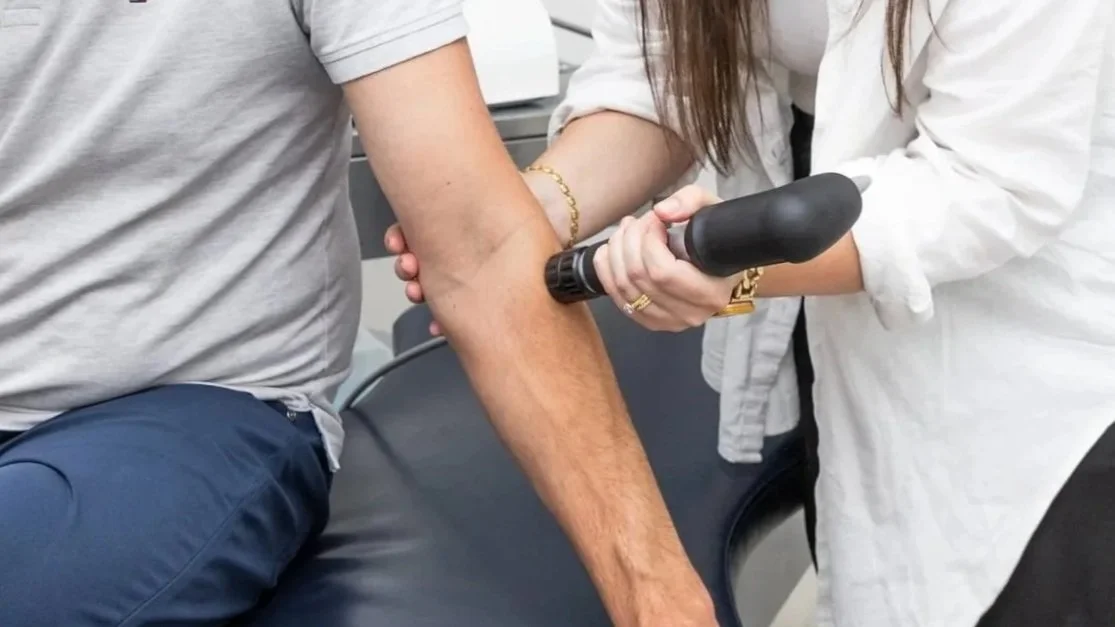
Shockwave treatment is delivered through a handheld applicator placed over the treatment area using coupling gel.
You'll feel repeated mechanical pulses through the tissue. Treatment can become uncomfortable when we work over a sensitive part of the tendon, but the intensity can be adjusted according to your tolerance. The treatment itself usually only takes a few minutes.
Some people notice temporary tenderness afterwards, while others notice an early reduction in pain.
In most cases, you can return to your normal daily activities without much modification. In some cases, we may advise you to hold off for a day or two from particular activities that we know aggravate your elbow.
How Many Shockwave Treatments Will I Need?
At our clinic, we commonly recommend 3–6 shockwave treatments, spaced approximately one week apart, including for chronic tennis elbow.
Every case is different.
Throughout treatment, we continue to monitor changes in pain, gripping, activity tolerance and function. If you're responding well, we continue to progress the treatment plan. If you're not responding as expected, we reassess and change direction where necessary. That may mean modifying treatment, investigating another potential contributor, or considering imaging or referral when appropriate.
Who Might Consider Shockwave for Tennis Elbow?
Shockwave may be worth considering when:
The decision depends on what we find during your assessment, what you've already tried and your goals.
When might shockwave not be appropriate?
Before treating anyone, we need to be confident we're treating the right problem.
Pain on the outside of the elbow isn't always tennis elbow. Certain nerve syndromes, elbow joint problems, referred pain and other musculoskeletal conditions can produce similar symptoms but require a different treatment approach.
There are also circumstances where shockwave treatment may be inappropriate or require additional caution. We screen for these as part of your assessment before treatment begins.
No additional shockwave fee.
At Southside Spine & Sport, shockwave therapy is included within your standard consultation fee.
We've chosen to operate this way because it gives us the clinical freedom to use the treatment we believe is most appropriate for your problem, rather than feeling obliged to use a particular machine or modality to justify an additional treatment fee.
Shockwave Therapy for Tennis Elbow FAQs
Does shockwave therapy work for tennis elbow?
Research has shown that shockwave can improve pain and function in people with chronic tennis elbow. More recent evidence has also reported benefits when shockwave is combined with exercise and favourable longer-term outcomes compared with corticosteroid injection.
Not everyone responds in the same way, so we assess whether shockwave is appropriate and monitor your response.
Is shockwave better than corticosteroid for tennis elbow?
A 2024 meta-analysis found corticosteroid injection produced better outcomes at one month, while shockwave produced better results for pain, grip strength and function at three months. At six months, shockwave continued to show better pain and grip-strength outcomes.
For many patients, this makes shockwave worth considering as a non-invasive treatment option before progressing to corticosteroid injection. The decision still depends on the individual presentation and treatment goals.
How many shockwave sessions are needed for tennis elbow?
We commonly use 3–6 sessions, spaced approximately one week apart. Every case is different, and shockwave forms one part of the overall treatment plan rather than determining the entire course of care.
Is focused or radial shockwave better for tennis elbow?
Both have research supporting their use. Current evidence doesn't establish one as consistently better than the other, and different protocols and shockwave types have performed better for different outcomes in different studies.
We have both focused and radial shockwave available and can select the approach according to your presentation and response.
Does shockwave therapy hurt?
It can be uncomfortable, particularly when treating a sensitive part of the tendon. The intensity can be adjusted during treatment, and the treatment itself usually lasts only a few minutes.
Can I exercise while having shockwave treatment?
Usually, yes. Progressive loading is often an important part of treating tennis elbow. We may temporarily modify aggravating activities or exercises, but the goal is generally to progressively load the tissue and restore function.
References
- Zhang L, Zhang X, Pang L, Wang Z, Jiang J. Extracorporeal Shock Wave Therapy Versus Local Corticosteroid Injection for Chronic Lateral Epicondylitis: A Systematic Review with Meta-Analysis of Randomized Controlled Trials. Orthopaedic Surgery. 2024;16(11):2598–2607.
- Comparison of extracorporeal shockwave therapy, ultrasound therapy, and corticosteroid injections for treatment of lateral epicondylitis: an umbrella review of meta-analyses. 2025.
- Tan MS, Karakuzu Güngör Z. The combined effect of radial extracorporeal shockwave therapy and exercise in lateral epicondylitis: A randomized controlled trial. Journal of Orthopaedic Science. 2026;31(5):1019–1026.
- Król P, Łojewski B, Król T, et al. Focused shock wave and ultrasound therapies in the treatment of lateral epicondylitis – a randomized control trial. Scientific Reports. 2024;14:26053.
- Wheeler PC, Tattersall C, Calver R. Radial extracorporeal shockwave therapy (rESWT) for patients with chronic lateral elbow tendinopathy (tennis elbow): A double-blinded randomised controlled trial. Shoulder & Elbow. 2026.
- Comparison of the efficacy of different types and intensities of extracorporeal shock wave therapy for lateral epicondylitis: a systematic review and network meta-analysis. 2026.
Is Shockwave Therapy Appropriate for Your Elbow?
If chronic elbow pain is making gripping, lifting, working or exercising difficult, we can assess what's contributing to the problem and whether shockwave therapy is appropriate for you.
Focused and radial shockwave therapy in Bicton, Perth — treating patients from Bicton, Melville, Palmyra, Attadale, Applecross, East Fremantle, Fremantle and surrounding areas.