Bulletproof Knees and Fall Resistant Ankles

WRITTEN BY DR RUSSELL JENSEN Principal Chiropractor
Southside Spine and Sport, Bicton WA
Practicing Chiropractor since 2015.
Trained in Integrative Diagnosis (USA).
Special interest in nerve entrapment conditions including cluneal nerve pain, sciatica, and piriformis syndrome.
Full profile: southsidespinesport.com.au/meet-our-chiro
Most of the functional pain issues that come through my clinic trace back to the same two things: inflexibility and weakness. Modern life keeps us in a narrow functional range. We move between standing, sitting in chairs, and lying on elevated surfaces like beds. That's fine right up until you have to get down to the ground, or pick something up off it. Getting up and down off the floor is one of the most common movements that flares up back and lower limb problems in my office, and building strong legs is the single best thing you can do to prevent it.
Recently a patient asked me what I thought of a YouTube channel called The KneesOverToesGuy. He'd found it after years of knee pain, started following some of the exercises, and was already feeling improvements. He wanted to know if it was legitimate and safe to keep following.
The short answer: yes, it's good information and safe for most people. If you have any concerns about applying that content to your specific situation, email me and I'll tailor it to you.
Even in my fittest patients, strength through a full range of movement is a challenge. The moment you're asked to step outside that narrow range, light task or heavy, you're putting your spine at risk of flaring up. The fix is building strength and flexibility through the full range of movement in the hips, knees and ankles.
Below are three starting exercises you can begin safely today.
The Three Exercises
Tib Raises
Single Leg Hamstring Bridges
Clam Shells
All three are performed at a slow, controlled 2-seconds-up, 2-seconds-down cadence. No pauses, just continuous slow movement: 15 repetitions, once or twice a day, for 30 days.
These exercises are deliberately simple so they're accessible to everyone, at any fitness level. If you find them too easy after a week or two, message me and I'll progress you to something harder. That's part of what I do for patients at Southside Spine and Sport: matching the exercise to where your body actually is, not a generic program.
Tib Raises
Tib raises strengthen the tibialis anterior, the muscle at the front of your shin that decelerates your foot with every step. It's a small muscle that does a disproportionate amount of work: absorbing forward momentum when you walk or run, controlling the landing when you cut and change direction in sport, and stabilising your ankle when the ground underneath you isn't level.
Stand with your heels together, back facing the wall, heels 30-40cm away from it. Lean back against the wall. Keeping your toes relaxed, lift your feet up by dorsiflexing your ankles, then slowly lower them back down. To make it harder, walk your feet further away from the wall.
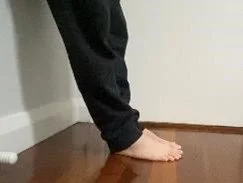
Start Position
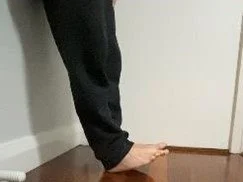
Finish Position
Hamstring Bridges / Hip Lift
If you only ever do one exercise, make it this one. It's that important for hip, knee and lower back health, and it deserves more credit than it usually gets.
Lie on the ground with your feet up on a stable bench or chair that won't move. Lift one foot so it hovers just above the surface. Press down through the other foot to lift your hips until they're straight. If you can't reach full extension at first, that's completely normal. Lift as high as you can, hold briefly, then lower back down slowly.
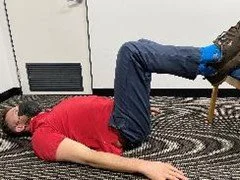
Start Position
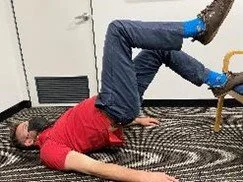
Finish Position
Clam Shells
Clam shells target the gluteus medius, a hip stabiliser that gets overlooked constantly despite doing a lot of the work in keeping your pelvis level while you walk, run or stand on one leg. Lie on your side with hips stacked, knees together, ankles together. Without rolling your torso, and keeping your ankles in light contact, lift the top knee. Lower it back down slowly until your knees touch again.
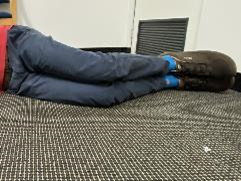
Start Position
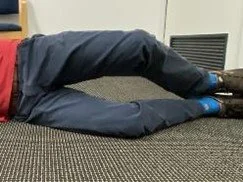
Finish Position
Did you know: roughly one in three adults over 65 falls at least once a year, and falls are one of the leading causes of injury-related hospital admission in older Australians. Strength and balance work like this isn't just about rehabilitation, it's fall prevention.
Why This Works
This isn't just anecdotal. A major Cochrane review of exercise-based fall prevention in community-dwelling older adults found strong evidence that programs built around balance and functional strength meaningfully reduce fall rates. The exercises above hit exactly that combination: ankle control, hip stability, and posterior chain strength, the same qualities that keep you upright when you trip, misstep, or have to catch yourself on uneven ground.
Reference: Sherrington C, et al. Exercise for preventing falls in older people living in the community. Cochrane Database of Systematic Reviews, 2019. View on Cochrane Library
What to Expect
Most people feel a strength difference within a week or two. But the real benefit comes from doing all three daily for a full month. If you've been dealing with on-again, off-again lower back pain, or getting up and down off the floor has become genuinely difficult, this is a good place to start.
If you'd rather have a real diagnosis before starting, or you want these exercises built into a broader rehab plan, that's exactly what a consult at Southside Spine and Sport is for.
I also work closely with local GPs, physios and osteopaths, so if you're already seeing someone for this, feel free to raise these exercises with them or bring them into your existing plan.
Frequently Asked Questions
How often should I do these exercises?
All three exercises can be done once or twice a day. Most people notice a strength difference within one to two weeks, but a full month of daily practice is ideal for lasting results.
Are these exercises safe for older adults or people worried about falls?
Yes. All three exercises are low-impact and build the exact combination of ankle control, hip stability and strength that research shows helps reduce fall risk in older adults.
Do I need any equipment?
No. You just need a wall for tib raises and a stable bench or chair for the single leg hamstring bridge.
What if these exercises feel too easy?
They're deliberately simple to make them accessible to everyone. If they feel too easy after a week or two, email me and I can progress you to something more advanced.
Can these help with knee pain from arthritis?
These exercises build general strength and stability around the knee and hip, which can help reduce load on an arthritic joint. If you have a specific diagnosis like arthritis, it's worth having a consult first so the exercises can be tailored to you.